
How to Choose an OEM loofah manufacturer Vietnam: The Definitive B2B Procurement Guide
The global shift toward environmental sustainability is no longer a niche consumer movement; it is an institutional procurement mandate. As brands across the United States, Spain, and the wider European Union race to strip single-use plastics from retail shelves, supply chain managers face a difficult challenge. Replacing synthetic polyurethane sponges with natural alternatives requires more than just finding a raw farm supplier. It demands a sophisticated manufacturing partner capable of maintaining strict corporate compliance, scalable production, and impeccable quality control.
For enterprises looking to dominate this eco-friendly market, selecting an OEM loofah manufacturing partner is the most critical decision of the fiscal year. Vietnam has rapidly emerged as the global epicenter for high-quality, fibrous agricultural exports. However, navigating the local manufacturing landscape requires deep industry insight.
This comprehensive B2B procurement guide breaks down the essential benchmarks for identifying, auditing, and partnering with a premier OEM loofah manufacturer Vietnam to secure your global supply chain.
1. Agricultural Foundations: Why Raw Material Origin Dictates B2B Scaling Success
In private-label consumer goods, your finished product is only as consistent as your raw agricultural source. Loofah (Luffa aegyptiaca) is highly sensitive to soil composition, rainfall variance, and agricultural techniques. When auditing a potential OEM loofah manufacturer Vietnam, your vetting process must begin at the root: the cultivation fields.
The Vulnerability of Fragmented Sourcing
Many small-scale Vietnamese suppliers operate via unorganized, middleman-driven networks. They purchase raw loofah from hundreds of independent, backyard smallholders. For an international brand, this introduces severe operational risks:
-
Inconsistent Fiber Density: Sponges from uncontrolled farms vary wildly in density, leading to unpredictable product lifetimes.
-
Dimensional Variance: Standardizing automated retail packaging becomes impossible when product diameters fluctuate by more than 30%.
-
Chemical Contamination: Unregulated pesticide use by independent farmers can cause container rejections at US Customs or EU borders due to strict chemical residue laws.
The Enterprise Standard: Verified Agricultural Networks
To safeguard your brand reputation, look for an overseas partner backed by structured, large-scale agricultural infrastructure. Leading operators establish localized supply stability by working directly with managed farming cooperatives.
[Agricultural Supply Chain Blueprint]
Managed Cooperative (VietGap Standards) ➔ Dedicated Post-Harvest Sorting ➔ Centralized Chemical-Free Factory Processing ➔ Global B2B Distribution
A prime example of this structured approach is HiBrews, which anchors its entire export supply chain across a network of 19 VietGap global farms throughout Vietnam. VietGap (Vietnamese Agricultural Practices) aligns closely with international GlobalG.A.P. parameters. This framework enforces meticulous record-keeping, strict soil management, pure water usage, and controlled, safe agricultural inputs.
By sourcing from an OEM loofah manufacturer Vietnam that controls its agricultural foundation, B2B buyers guarantee a predictable fiber matrix, stable color uniformity, and a reliable, year-round volume cushion that insulates against seasonal crop failures.

2. De-seeding, Washing, and Drying: Vetting Chemical-Free Processing Protocols
The industrial transformation of a raw agricultural gourd into an elegant, shelf-ready retail kitchen sponge or luxury spa pad requires precise post-harvest processing. Many low-cost manufacturers cut corners during this phase, using harsh industrial chemicals to accelerate production. B2B buyers must meticulously audit these processing methods to protect consumer safety and brand values.
The Hidden Danger of Chemical Bleaching
To achieve a bright, uniform off-white or light yellowish hue, many standard factories submerge raw loofah fibers in heavy industrial chemical baths containing sodium hypochlorite (household bleach), hydrogen peroxide compounds, or sulfur dioxide gas.
While this rapidly sanitizes the product and masks aesthetic imperfections, it leaves behind structural vulnerabilities:
-
Fiber Degradation: Chemical bleaching breaks down the natural cellulose walls of the loofah, reducing its natural elasticity and shortening its operational lifespan by up to 50%.
-
Chemical Residues: Trapped chemical traces inside the dense fiber networks can leach out when consumers use the product in hot water, causing skin irritation or contaminating kitchenware.
-
Environmental Degradation: Discharging chemical-laden wastewater into local ecosystems violates global environmental, social, and governance (ESG) standards.
The Clean Solution: Pure Water and Thermal Processing
A premium OEM loofah manufacturer Vietnam relies entirely on chemical-free processing methods. The natural processing method uses mechanical pressure, natural enzyme fermentation, and pure water rinsing to remove the outer skin and seeds.
[Pure Water & Thermal Processing Sequence]
Raw Gourd Harvest ➔ Pure Water Softening ➔ Mechanical De-seeding ➔ Natural Sun/Thermal Oven Drying ➔ Multi-Stage Compressed Grading
Once cleaned, the loofah fibers are dried in controlled thermal ovens or solar drying facilities to achieve an optimal moisture level of 10% to 12%. This exact range prevents mold development during long maritime shipping transit times without making the fibers brittle.
When you partner with an ethical organic loofah supplier, your finished products retain their rich natural textures, subtle earthy scent, and robust structural integrity. This ensures your products stay resilient through hundreds of scrub cycles on Amazon or retail shelves.
3. Industrial Customization Capabilities: From Raw Fiber to Private Label SKU
A true original equipment manufacturer must be more than just a farm aggregator; they must operate an advanced industrial manufacturing facility. In the competitive e-commerce and retail landscapes, unique product differentiation is your most powerful tool. Your chosen OEM loofah manufacturer Vietnam must offer diverse, precise engineering and tailoring options.
When auditing a factory’s engineering floor, verify their proficiency across these three primary production formats:
A. Raw Loofah Slices and Intact Cylinders
Ideal for industrial zero-waste supply houses, cosmetic manufacturers, and artisan soap makers who pour natural glycerin directly into the loofah matrix.
| Specification Metric | Target Industry Standard | Compliance Tolerance |
| Cylinder Length | 10 cm to 15 cm (Customizable) | +- 0.5 cm |
| Slice Thickness | 1.5 cm to 2.5 cm | +- 0.1 cm |
| Fiber Density | Medium-Firm High-Exfoliation | Pure Mechanical Sorting |
| Moisture Content | $10\% – 12\%$ | Moisture Meter Verified |
B. Compressed Kitchen Scrubber Sponges
Modern consumers prefer space-saving, ergonomic kitchen tools. High-tier manufacturers utilize heavy-duty hydraulic press machinery to flatten natural loofah shapes down to ultra-thin profiles ($1\text{ mm}$ to $2\text{ mm}$).
This engineering approach saves massive amounts of space during international shipping container transit, drastically dropping your per-unit landed costs. Once the end-consumer drops the sponge into water, it instantly expands back into its full, bouncy, three-dimensional shape.
C. Compound Spa Pads and Multi-Layer Bath Mitts
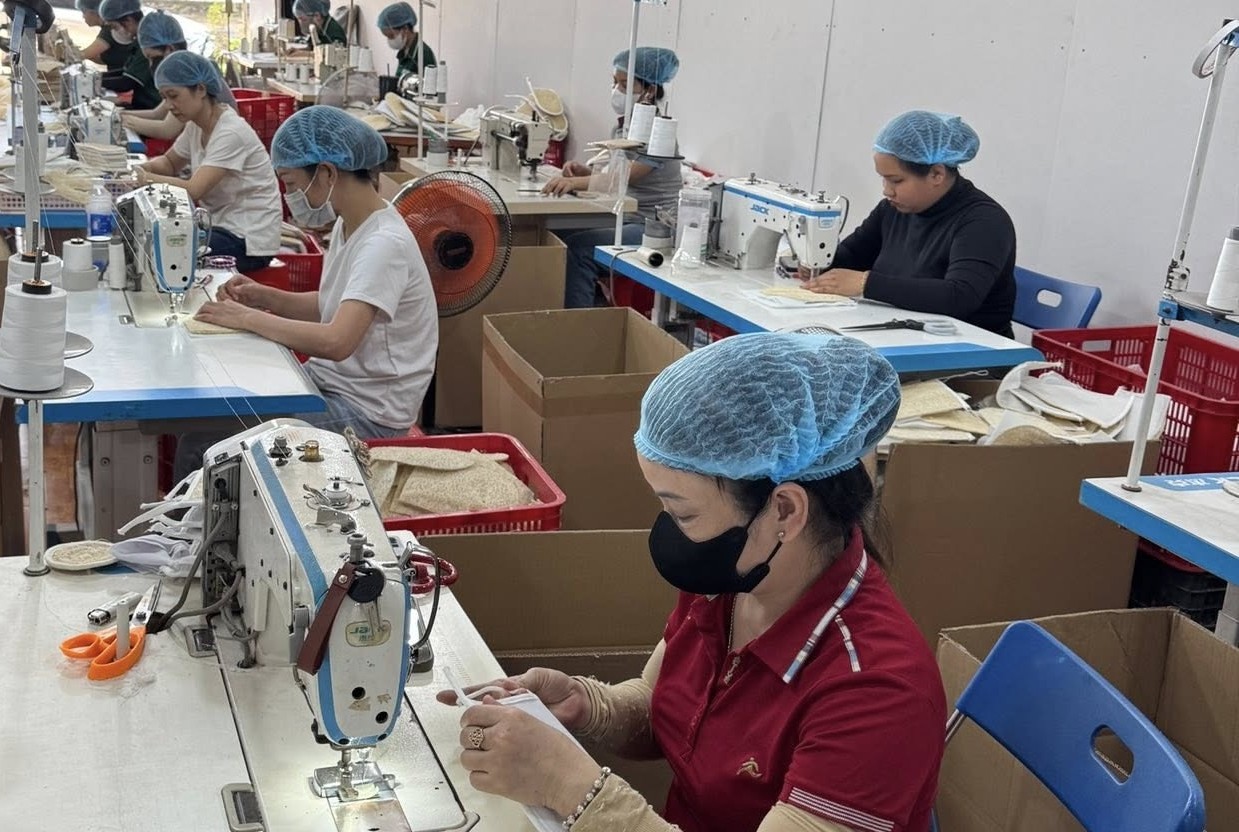
Premium bath accessories require combining natural loofah with other sustainable textiles like organic Egyptian cotton, unbleached linen, or wild ramie fibers. Ensure the factory houses specialized heavy industrial sewing machines and uses strong, water-resistant cotton threading. Avoid suppliers that rely on chemical adhesives or glues to bond multi-layer bath pads, as these glues will dissolve and separate in warm water.
4. Technical Audit Checklist: Evaluating Manufacturing Infrastructure
Before transferring a deposit payment to an organic loofah supplier in Vietnam, your procurement team should execute a strict technical audit. If a physical on-site visit to the factory is logistically challenging, request a live, high-definition video walkthrough of their production floor. Use this checklist to score their operational capabilities:
-
[ ] Raw Material Separation: Does the factory separate incoming farm harvests from the clean processing zones to prevent cross-contamination?
-
[ ] Hydraulic Press Capacities: Do they possess heavy industrial hydraulic machinery capable of uniform compression for high-volume private label Amazon orders?
-
[ ] Die-Cutting Precision: Do they use laser-guided or sharp mechanical die-cut molds to ensure perfectly clean edges on custom shapes (like stars, hearts, or ergonomic ovals)?
-
[ ] In-Line Metal Detection: Does the factory route finished goods through a calibrated metal detection conveyor belt to catch broken sewing needles or machinery fragments before packaging?
-
[ ] Moisture Management Controls: Does the quality assurance team use calibrated digital pin-type moisture meters on every production batch prior to sealing?
-
[ ] Worker Welfare Standards: Is the manufacturer operating under fair-trade principles, providing clean air filtration, fair wages, safe machine guards, and comfortable working conditions for their local craftspeople?
5. Seamless B2B Logistics: Shipping, Customs, and International Documentation
The final hurdle in international product sourcing is moving your freight across global waters without dealing with costly customs delays or unexpected demurrage fees. A professional OEM loofah manufacturer Vietnam must have an experienced internal logistics team that understands the complex import rules of Western markets.
Critical Regulatory Documentation for US & EU Entry
To pass through US Customs and Border Protection (CBP) or EU customs smoothly, your shipment must be accompanied by accurate paperwork. Minor clerical errors can lock up your container for weeks. Ensure your Vietnamese partner handles and delivers these foundational documents correctly:
-
Fumigation Certificate: Because loofah is a natural plant product, international maritime law requires your container to undergo professional fumigation (usually with Methyl Bromide or Phosphine) before departure. This prevents the cross-border spread of localized pests.
-
Phytosanitary Certificate: Issued by the Ministry of Agriculture and Rural Development of Vietnam, this certificate officially verifies that your batch has been inspected and is completely free from regulated agricultural diseases and hazardous pests.
-
Certificate of Origin (C/O Form B or Form EUR.1): Proves the goods were entirely grown and processed in Vietnam. For European Union buyers, a valid C/O or REX system registration helps tap into preferential tariff rates under the EU-Vietnam Free Trade Agreement (EVFTA).
[B2B Export Compliance Pipeline]
Factory Quality Sign-off ➔ Professional Container Fumigation ➔ Government Phytosanitary Inspection ➔ Port Customs Clearance (Hai Phong/Da Nang/Cat Lai)
Flexible Incoterms for International Buyers
Your partner should accommodate various international commercial terms based on your organization’s logistics setups:
-
FOB (Free On Board): The factory delivers your goods safely to a major Vietnamese ocean port (such as Cat Lai Port in Ho Chi Minh City or Hai Phong Port). Your freight forwarder takes over from there.
-
EXW (Ex Works): Your logistics team handles the entire journey, picking up cargo directly from the factory warehouse doors.
-
DDP (Delivered Duty Paid): Ideal for growing e-commerce brands or Amazon FBA businesses. The manufacturer manages the entire end-to-end journey, covering ocean freight, import duties, and final domestic trucking straight to your fulfillment center warehouse doors.

6. Initiating Your Procurement: The Power of Trial Orders
In enterprise-level purchasing, plunging directly into a massive 40-foot container order without checking real-world product performance is an unnecessary gamble. A reliable, transparent OEM loofah manufacturer Vietnam understands this completely and welcomes low-risk verification testing.
Before signing a long-term supply contract, always secure an initial batch of physical samples. This allows your product development team to perform vital stress tests:
-
Expansion Velocity: Drop compressed loofah samples into water and measure how many seconds it takes to reach full volume.
-
Abrasiveness Profile: Test the fiber texture to ensure it is tough enough to scrub away grease but gentle enough not to scratch non-stick pan coatings or sensitive skin.
-
Tensile Strength: Pull forcefully on the woven cotton edges of custom spa pads to verify the stitch durability.
Take the Next Step with HiBrews
If you are ready to elevate your product lineup with sustainable, pure, high-performance Vietnamese loofah, HiBrews makes the onboarding process simple and stress-free. Backed by our resilient network of 19 VietGap global farms and deep expertise in chemical-free processing, we specialize in supporting ambitious private labels, international distributors, and conscious eco-brands.
Skip the guesswork and experience our premium quality firsthand. Visit our B2B trial order portal today to order bulk loofah samples tailored exactly to your brand’s unique size, shape, and design specifications.
For custom corporate consultation, corporate audits, or large wholesale contract inquiries, please Inquire loofah wholesale through our dedicated logistics desk. Our enterprise management team will guide you smoothly through every stage of production, compliance, and international shipping.
Connect and Grow with Us Internationally
To stay updated on the latest shifts in sustainable manufacturing, agricultural updates, global trade dynamics, and upcoming product lines, connect with our digital corporate channels:
-
Follow professional business insights from our founder via CEO Hibrews Nguyen LinkedIn.
-
Engage with our active global eco-community on HiBrews Eco Facebook.
-
Watch behind-the-scenes factory footage and farm tours on the HiBrews YouTube Channel.
-
Explore our beautiful, retail-ready product designs on HiBrews Instagram.

Leave A Comment